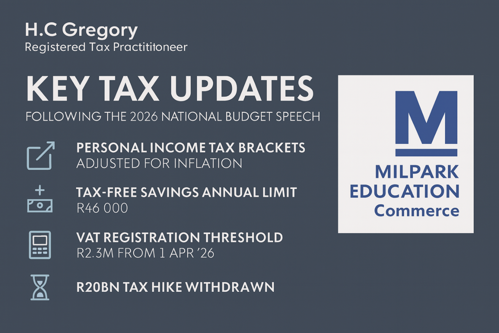
The Budget 2026 speech delivered by the Finance Minister on 25 February was generally well received. Especially welcome was the much-needed tax relief for individuals and small and medium business owners.
The focus of this piece is placed on the long-outstanding VAT threshold adjustment and why it was so necessary.
In 2009 the VAT threshold was established at R1 000 000 (one million rand). That means if you expected your annual turnover as a small business to reach that amount you were required to register for VAT (Value Added Tax).
This form of direct tax is charged on almost all goods and services. Let’s use an example of a hairdresser in a busy mall. Your business is thriving, you’ve employed several staff and, at the current rate of turnover, you seem certain to earn revenue in excess of R1 000 000 in the next 12 months.
If VAT is levied at 15% how does this affect your business and what does it mean for your customers? Say you charge R200 for a gent’s haircut. That means you must now add R30, charging the customer a total of R230 for the same haircut you charged R200 for six weeks prior.
Now, some customers may be happy to pay the extra R30 as they value the services you offer. Others, however, will look for a cheaper option in response to this sudden increase, leading to a loss of revenue.
But what if we factor in the upcoming year? Will you be able to adjust your prices to match inflation? To determine the likely rate of inflation, we must look at the latest CPI data. CPI gives us an indication of how prices have risen over the past year or longer. So, let’s apply this to the threshold and see if the adjusted amount is fair in relation to the period 2009 to 2026:
So, we can see this threshold has moved by 55.8%. If we calculate the inflation factor, we would do so as follows:
Inflation factor = 102.8 ÷ 47.0. That gives us 2.187234043.
If we apply that to the threshold – R1 000 000 × 2.187234043 – we get an adjusted threshold of R2 187 234.04.
If we then compare it to the new threshold – R2 300 000 – we can see that this adjustment is both fair and takes the relevant period of time into consideration.
Read More: The M-Word: We need to talk about it
Let’s work out how many small businesses or SMEs fall into this category in the following way:
Now let’s wrap up before our mathematical brains start to drift to what we’ll be making for supper:
Read More: Milpark Launches Immersive Online Learning Model for 2026
The 32.7% number of registered VAT vendors (488 118 x 32.7%) amounts to 159 615 vendors – of which 6.84% will benefit from this increase. This means a total of 10 918 businesses will no longer need to have their prices inflated by adding an additional 15% of VAT.
That, in turn, means over 10 918 businesses will no longer incur compliance costs that eat into the business’s profits. Their products will therefore become instantly cheaper, a major benefit in these trying times.
By analysing the VAT threshold increase we can see how it will have a remarkable impact on the SME space in South Africa over the 2026/2027 financial period.
Furthermore, it will allow for a much-needed boost to the overall performance of the economy. It may be only 10 000 or so traders who benefit but that will create a larger knock-on effect to drive the economy overall.
If you are looking to advance your career in the world of finance and tax, explore our programmes and apply for a programme tailored to your needs.